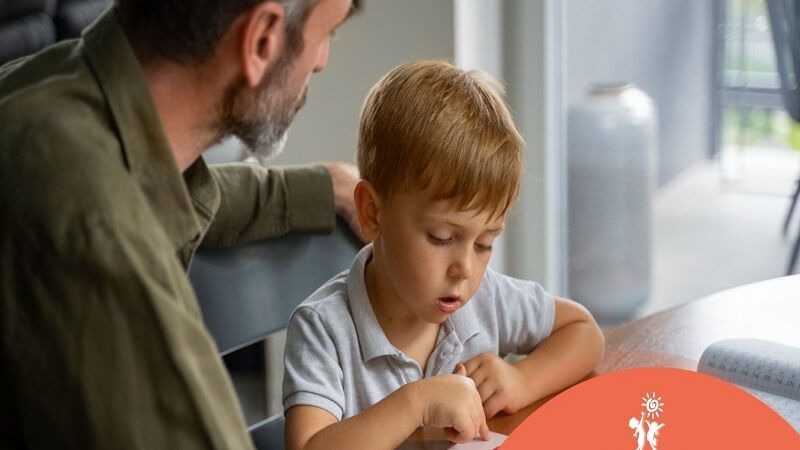
8 year old Marcus had trouble maintaining eye contact with others and had a very limited vocabulary. His parents felt sad because they watched younger kids talk excitedly about things that are going on in their world and wondered if Marcus would ever experience such relationships. Three years later, 11 year old Marcus is engaging in conversations with his peers and classroom teachers and following multi step directions for a variety of tasks and activities.
The Foundation of Systematic Skill Building
Unlike other forms of therapy, ABA centers look at complex behaviors as a series of parts that can be taught. Unlike placing a child in a learning environment and hoping they absorb the skills and knowledge necessary to reach their full potential, ABA centers provide a structured learning environment to help teach and grow a child.
Our initial assessment program provides and overview of where your child is on a developmental continuum for various skill areas. Rather than solely focusing on your child’s deficits, we highlight your child’s current levels of development and build upon his or her strengths.
These language and social skills are presented from simple to more complex. At first, a child begins by establishing contact and following directions, and then progresses to a reciprocal conversation. Each skill builds upon the foundation of previous skills and, together, they compound over months and years as consistent intervention is delivered.
Communication Development Beyond Words
Speech is one of the most visible areas in which ABA centers can leave a lasting and positive impact on a child’s life. However, the work of ABA centers extends far beyond of a child’s first “mama.” The ultimate goal is for the child to acquire a functional mode of communication that will be adaptive throughout his or her life span and that will enable him or her to meet his or her needs now and in the future through spoken word or alternative and augmentative forms of communication.
Children with significant speech or language impairments often begin using alternate forms of communication. Sometimes referred to as AAC (Augmentative and Alternative Communication) methods, these children use a variety of approaches to communicate such as using picture communication symbols to form sentences, using sign language to label objects and actions, or using electronic devices to help them express their thoughts and needs. The key for these children is not that there is a “best” way to use these tools, but that they have a method to communicate their needs, wants and ideas.
Even as vocabulary and grammar are important to teach to a child with autism, it is also important to work on more practical aspects of communication such as when it is time to speak and how to have a conversation with someone else. These skills of sharing a conversation, pausing for another speaker to contribute, and even altering one’s style of communication in order to match the needs of the listener or the situation, are vital to the kid with autism in the teenage years and young adulthood as they complete their academics and later their job, and maintain relationships with peers, parents and employers.
Social Skills That Transfer Across Environments
While teaching children to say please and thank you is often part of the repertoire of teaching social skills to individuals with Autism Spectrum Disorder (e.g. in an ABA center), I believe the skillset can be much more in depth than simple manners. In addition to learning to ask for things appropriately and expressing gratitude to others for their efforts and gifts, Social Skills are a critical component of an individual’s repertoire in ANY setting! Meaningful interaction with others can occur in an ABA center, at school or in a community setting; the skills are transferable. In addition, while many of the Rules governing physical space and proximity may be informal and often go unspoken, they can be quite confusing to those providing support to the individual, ie. parents or staff.
In addition to teaching children with autism and other social-aural learning differences (e.g. ADHD, PDD-NOS) social skills, I also support their practice of those skills in a supportive environment. Structured practice of social skills allows a child to put recently learned concepts into action, and turning what would otherwise be mistakes into lessons rather than embarrassment is a big part of what I do. Practicing social interactions also helps the child become aware of things like facial expressions, tone of voice, and physical space that typically go unnoticed by neurotypical individuals.
Quality centers provide opportunities for individuals with autism spectrum disorders to generalize the skills they are learning through positive and active learning experiences in playgrounds, community based classrooms, and other community settings. Many of the quality centers include community outings and peer interactions, and train staff to support children in those activities. This ABA center in Boston, MA is an example of this type of training.
Building Independence for Adult Life
Our long-term focus is essential to our ABA intervention: helping the children’s centers develop students who will be independent as adults.
Independence is a skill that begins with dressing and toileting and progresses throughout the years to include things such as time management, problem solving and decision making. Our children are currently able to follow a routine; complete multiple step tasks and make good choices with a variety of options.
Vocational skills and practical life skills that promote safe living are highlighted to assist young people with physical disabilities to acquire skills for independent living in the future. Skills for safe living include the skills children with disabilities need to go out into public places, interact with strangers and respond to situations that could pose a risk of harm to themselves. These are practiced repeatedly and through repetition become automatic. The same skill that a child with a disability needs to be able to cross a busy road safely is the same skill that the adult with a disability will need to cross a busy road safely.
Family Training and Consistency
Studies have shown that isolated center-based intervention is not sufficient to support lasting developmental change for children with autism spectrum disorders. Therefore, ABA centers typically put a great deal of time and resources into teaching parents strategies to implement at home and in community settings in order to maximize intervention effectiveness.
Parents and caregivers learn same techniques used by therapists to support their children. They learn to 1) break down tasks into steps (decompose), 2) use consistent and effective prompts, and 3) deliver reinforcement for desired positive behaviors. By using these techniques in home, community, and other natural settings in which students experience typical daily tasks, students learn to generalize their learned skills more rapidly and avoid confusion and negative effects of behavior that can occur when parents and therapists use different methods.
Strategies taught in training need to evolve as children get older. In addition to strategies to support preschoolers, Banyan Tree also supports families learn strategies to support teenagers who face increased peer pressure, more rigorous schoolwork, and other unique adolescent challenges. Families also learn how to be effective advocates for their child and her needs in school and other settings.
Data-driven Adjustments
Quality ABA Center: Some Things to Look For… – Data collection and analysis. Not just tracking of data, but use of the data to look at multiple measures and make programming adjustments based on the data, not on wishful thinking or anecdotal reports.
Work should be done to ensure children and young people are not left in ineffective programmes for too long. Evidence-based techniques are used to support the planning and implementation of work with children and young people. These techniques are refined or replaced as evidence comes to light that they are not effective. The amount and intensity of the support required by a young person will determine the level and focus of the work needed to help them move on. Decisions should be made on the basis of objective evidence about their skills, needs and abilities. Some young people will require a long-term, intense piece of work, while others will need a shorter, more time limited intervention in order to develop the skills they need.
The children most in need of an ABA program are the ones who will benefit the most from our program. They will use the skills learned decades after they graduate from our center for employment, relationships and civic participation.