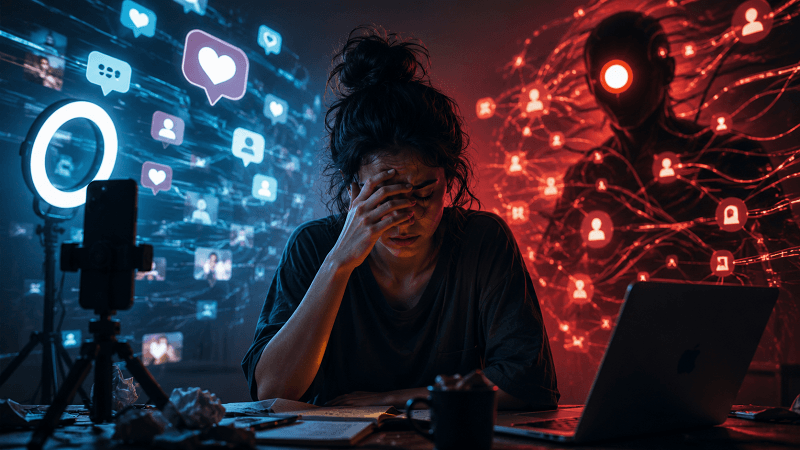
Content creation used to sound like the dream job. Post videos. Build an audience. Work from anywhere. Turn your personality, taste, humor, beauty routine, gaming skill, parenting hacks, or hot takes into income.
And honestly, for some people, it still is a dream. It can pay bills. It can open doors. It can make a person feel seen after years of being ignored by traditional media. But the shiny part of the creator economy hides a harder truth: being “always online” is not just a lifestyle. It’s a performance job that rarely clocks out.
The algorithm doesn’t care if you slept badly. It doesn’t care if your kid is sick, your skin is breaking out, your relationship is tense, or your anxiety is loud that morning. It rewards activity. It rewards speed. It rewards consistency. And when your income depends on showing up, disappearing can feel risky.
That’s where burnout starts to creep in. Not loudly. Not all at once. More like a slow battery drain while every app keeps running in the background.
The Algorithm Likes Consistency. Humans Need Breaks.
Here’s the thing: platforms train creators to think in patterns. Post at this hour. Reply fast. Watch your retention rate. Study the comments. Test the hook. Recut the intro. Try the trend before it goes stale.
That sounds practical. It’s work, after all. But it also turns creative instinct into a dashboard.
A creator isn’t just making content anymore. They’re tracking reach, saves, shares, watch time, affiliate clicks, brand approvals, and audience mood. One video underperforms and suddenly the whole day feels off. Was the topic wrong? Was the lighting bad? Did the audience move on? Did the platform bury it?
You know what? That kind of feedback loop gets personal fast.
For creators, the product is often tied to the self. Their face, voice, home, body, story, humor, and grief can all become content. So when a post flops, it doesn’t always feel like a business metric. It can feel like rejection.
That’s exhausting in a very specific way. It’s not only tired eyes from too much screen time. It’s emotional whiplash. One day, thousands of strangers love you. The next day, the same crowd is silent.
Content Creation Became a 24/7 Performance Job
The creator economy runs on constant availability. Fans expect replies. Brands expect polish. Platforms expect volume. Trends expect speed.
And the creator? They’re expected to make it all look easy.
That’s the strange part. A polished post can hide a messy day. A smiling livestream can happen after a panic spiral. A cheerful “get ready with me” video can be filmed by someone who hasn’t had a real break in weeks.
This is where the job gets blurry. Traditional workers usually have some kind of boundary, even if it’s imperfect. There’s a shift, a manager, a role, a place to leave. Creators carry work in their pocket. Their phone is both office and stage. Their bedroom can become a studio. Their dinner can become a reel. Their bad day can become engagement.
It’s no wonder many creators feel like they’re never fully off.
Even rest becomes content. Beach trip? Film it. Coffee run? Film it. Morning routine? Film it. Breakdown? Maybe film that too, but make it “raw,” not too raw, because the internet loves vulnerability until it gets uncomfortable.
That pressure turns daily life into a kind of soft surveillance. Creators start watching themselves through the eyes of an audience. Would this make a good post? Is this relatable? Is this too boring? Is this too private?
And once your private life becomes part of your public brand, burnout doesn’t feel like a normal workplace issue. It feels like losing access to yourself.
Burnout Isn’t Just a Wellness Problem. It’s a Revenue Problem.
A StreetInsider-style angle here matters because burnout is not only about feelings. It hits the business model.
Creators are small media companies now. Some are also talent, editor, producer, salesperson, customer support, accountant, stylist, and crisis manager. When they burn out, output drops. When output drops, reach can fall. When reach falls, brand deals get harder to secure. Revenue becomes less predictable.
That’s a real business risk.
A creator can have 500,000 followers and still feel financially unsafe if their income depends on monthly campaigns, affiliate spikes, or platform changes they don’t control. One algorithm tweak can change everything. One controversy can scare off sponsors. One long pause can make the audience drift.
So creators keep going.
They post while tired. They accept deals that don’t fit. They reply to comments when they need sleep. They film through stress because consistency feels safer than silence.
But that strategy has a cost. Burned-out creators often lose the exact thing that made people follow them: spark. Their voice gets flatter. Their ideas feel recycled. Their posts become efficient but empty. It’s like a restaurant that keeps serving meals after the kitchen staff has stopped caring. The plates still come out, but something is missing.
Audiences notice, even if they can’t name it.
The Emotional Labor No One Puts on the Invoice
There’s another layer people miss: creators perform emotional labor all day.
They manage parasocial closeness. They comfort followers. They absorb criticism. They turn pain into lessons. They stay warm, funny, grateful, and “real” without becoming too messy for advertisers.
Honestly, that’s a tightrope.
A beauty creator might get comments about their skin, weight, age, or face shape. A parenting creator might get judged for every choice. A fitness creator might be accused of promoting unrealistic standards. A mental-health creator might become the unofficial therapist for thousands of strangers.
And yes, criticism comes with public work. But volume changes the impact. One rude comment is annoying. Hundreds can feel like a storm through the nervous system.
The creator has to process all of it while still producing the next piece of content. That’s the part people don’t see. They see the post. They don’t see the creator staring at analytics at midnight, refreshing a video that should’ve done better.
Some creators cope by working more. Some numb out. Some lean on caffeine, alcohol, sleeping pills, or other habits that help them stay functional for a little while, until they don’t. When stress starts to spill into substance use, resources like Detox in Washington become part of a larger conversation about how pressure, performance, and health can collide behind the screen.
The Audience Wants Realness, But the Market Wants Control
There’s a contradiction at the center of creator life. Audiences want authenticity. Brands want safety.
Creators are told to be vulnerable, but not unpredictable. Honest, but not too heavy. Funny, but not offensive. Stylish, but not fake. Available, but not desperate. Human, but still consistent enough for the content calendar.
That’s a lot.
A creator might share a hard moment and get praised for being brave. Then, if they share too many hard moments, followers complain that the content got negative. A creator might take a break and get support, but if the break lasts too long, the algorithm stops pushing their posts.
So the creator learns to package emotion. Sadness becomes a caption. Anxiety becomes a carousel. Burnout becomes a “life update” with good lighting.
This doesn’t mean creators are fake. Most aren’t. It means the system trains people to edit their humanity into formats that perform well.
That editing can become tiring. Very tiring.
The Hustle Story Is Wearing Thin
For years, creator culture sold the hustle story: post daily, build your niche, stay consistent, ignore the haters, monetize your audience.
Some of that advice still works. Consistency matters. Skill matters. Timing matters. But the old hustle story leaves out the human body. It leaves out sleep, grief, hormones, family stress, rent, loneliness, and the weird ache of being watched all the time.
And now, the cracks are easier to see.
More creators talk openly about taking breaks. Some leave platforms for newsletters, podcasts, private communities, or slower work. Some build teams because solo creation turns into a hamster wheel. Others keep posting but quietly reduce how much of themselves they give away.
It’s not laziness. It’s survival.
The creator economy is growing up, and with that comes a less glamorous truth: attention is not the same as stability. Followers are not the same as support. Going viral is not the same as feeling okay.
What Burnout Looks Like Behind the Feed
Burnout doesn’t always look dramatic. Sometimes it looks like a creator posting on schedule while feeling nothing.
It can look like:
- filming three videos and deleting all of them
- avoiding comments because every word feels sharp
- feeling jealous of friends who have normal jobs
- waking up and checking analytics before drinking water
- saying yes to a brand deal just to feel safe
- feeling guilty for resting
- turning every life event into possible content
That last one is big. When everything becomes material, life starts to feel less lived and more harvested.
A walk isn’t just a walk. It’s B-roll. A meal isn’t just a meal. It’s a chance to post. A hard lesson isn’t just private growth. It’s tomorrow’s carousel.
That kind of thinking can drain joy from ordinary moments. And ordinary moments are where people recover.
The Future Belongs to Creators Who Can Last
The next phase of the creator economy will not only reward people who post the most. It will reward people who can last.
That means creators, agencies, and brands are starting to look beyond vanity metrics. A creator with a smaller but steadier audience can be more valuable than one who burns bright and vanishes. A creator who protects trust can build better revenue than one chasing every trend.
Burnout threatens that durability. It weakens creative judgment. It strains audience connection. It makes every platform shift feel like a personal emergency.
The algorithm will always push for more. More posts. More reactions. More time online. More emotional access.
But humans don’t run like software. They pause. They glitch. They need quiet. They need privacy. They need parts of life that don’t get turned into content.
And maybe that’s the real story behind the “always online” creator. The internet sees the upload. The business sees the reach. The platform sees the data.
But behind all of that is a person trying to stay visible without disappearing from themselves.