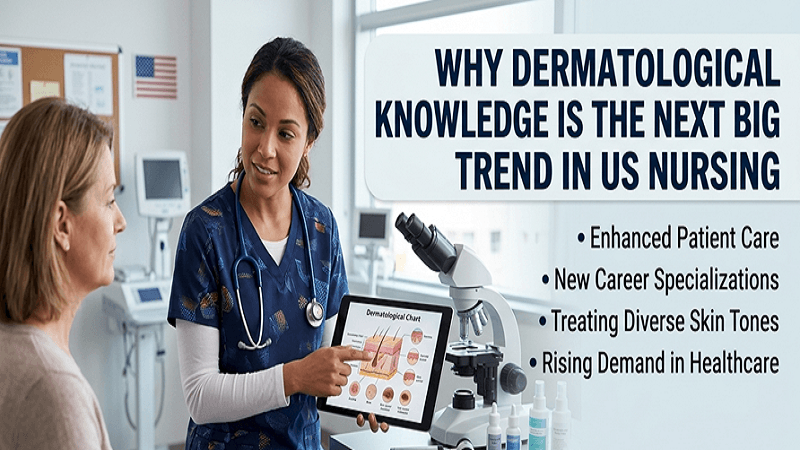
In the rapidly shifting landscape of American healthcare, nursing specializations often follow the trajectory of patient demand and technological innovation. While critical care and emergency nursing remain the bedrock of the profession, a new, sophisticated trend is emerging: Dermatological Nursing. Once viewed as a niche area of “skin and rashes,” dermatology has transformed into a high-stakes, high-revenue, and clinically complex field.
The skin is the body’s largest organ, and its health is increasingly recognized as a window into systemic wellness. In 2026, the convergence of an aging population, the explosion of the $24 billion U.S. skincare market, and the rise of medical aesthetics has positioned dermatological knowledge as a “must-have” skill set for the modern nurse.
The Clinical Imperative: Beyond the Surface
For years, dermatological education was a minor footnote in many nursing curricula. However, data from recent years shows that nearly 35.5% of patients presenting to primary care in the U.S. have at least one skin-related complaint. From chronic conditions like psoriasis and eczema to the rising incidence of skin cancers—with over 3.5 million cases treated annually—the need for expert clinical assessment is staggering.
Nurses who possess advanced dermatological knowledge are better equipped to identify early-stage malignancies and manage complex wound care. This expertise is particularly vital in aged care, where skin integrity is a primary indicator of overall health. When students or professionals feel overwhelmed by these complex clinical requirements, seeking Nursing Assignment Help can provide the necessary academic scaffolding to master these intricate subjects. By bridging the gap between theory and practice, specialized support ensures that future nurses can meet these rigorous dermatological standards.
The Surge of Medical Aesthetics and “Derm-Tech”
Perhaps the most visible driver of this trend is the rise of medical aesthetics. The U.S. Bureau of Labor Statistics (BLS) projects a 7% growth for skincare specialists through 2034, but the real opportunity lies with Registered Nurses (RNs) and Nurse Practitioners (NPs) who can perform medical-grade treatments.
1. The Aesthetic Shift
Nurses are increasingly moving into “MedSpas” and private dermatology practices. With average salaries for aesthetic nurse practitioners ranging between $70,000 and $120,000, and high-tier injectors earning upwards of $200,000, the financial incentive is clear. However, these roles require more than just a steady hand; they demand a deep understanding of facial anatomy, pharmacology, and skin histology.
2. The AI Revolution (2026 and Beyond)
In 2026, dermatology is at the forefront of “Augmented Medicine.” AI-driven diagnostic tools now assist nurses in mapping skin lesions and tracking changes over time. Nurses are no longer just caregivers; they are interpreters of data. This digital transformation requires a high level of technical literacy, often necessitating the use of professional assignment writing services to keep up with the evolving research and documentation standards required in modern healthcare settings.
Why US Nurses are Specializing in Dermatology Now
Several socio-economic factors have created a “perfect storm” for this specialization:
- The Aging “Baby Boomer” Generation: Older adults require more intensive skin monitoring for pressure ulcers, actinic keratosis, and age-related dermatoses.
- Preventative Health Culture: Younger generations (Gen Z and Millennials) are prioritizing “preventative aesthetics” and sun-protection education more than any previous cohort.
- Telehealth Expansion: Dermatology is one of the most telehealth-friendly specialties. In 2026, teledermatology has become a standard workflow, allowing nurses to manage patient follow-ups and medication monitoring (like isotretinoin) remotely.
Key Takeaways for Nursing Professionals
- Market Growth: The U.S. skincare industry is projected to approach $32 billion by 2032, increasing the demand for clinical experts.
- Diverse Roles: Opportunities range from clinical research and oncology skin care to high-end aesthetic injecting.
- Educational Gap: There is a significant shortage of dermatology-trained primary care providers, making this a high-value niche for NPs.
- Tech Integration: AI and telehealth are redefining dermatological workflows in 2026.
Frequently Asked Questions (FAQs)
Q1: Do I need a special license to work in dermatology?
While you only need an RN license to start, obtaining the DNC (Dermatology Nurse Certified) credential through the Dermatology Nurses’ Association (DNA) is highly recommended to improve your career prospects and salary potential.
Q2: Is dermatology nursing less stressful than hospital nursing?
It is often perceived as having a better work-life balance, as most dermatology clinics operate on a standard 9-to-5 schedule without the overnight shifts common in acute care. However, it requires extreme attention to detail and carries significant clinical responsibility.
Q3: How is AI changing the role of the dermatology nurse?
AI acts as a “second opinion” for lesion identification and automates administrative tasks like EHR documentation, allowing nurses to focus more on patient education and emotional support.
Q4: Can I enter aesthetics directly after nursing school?
Most reputable clinics prefer at least 1-2 years of general clinical experience. However, specialized training in neurotoxins and fillers can be started immediately through accredited continuing education programs.
About the Author
Angelika S. is a Senior Academic Consultant and Nursing Specialist at MyAssignmentHelp. With over a decade of experience in healthcare education and a focus on advanced clinical specializations, Angelika helps nursing students navigate the complexities of modern medical curricula. Her work focuses on bridging the gap between traditional nursing care and emerging healthcare technologies.
References
- U.S. Bureau of Labor Statistics (2024). Skincare Specialists: Occupational Outlook Handbook.
- AMN Healthcare (2026). AI in Dermatology: What Physicians and Nurses Can Expect.
- Journal of the American Academy of Dermatology (2025). The Psychological Impact of Chronic Skin Disease.
- Grand View Research (2024). U.S. Skincare Market Size & Trend Analysis Report